






Understanding How Smart Polymer Solutions Transition to Gels Around Body Temperature
2026.01.28
Research
Thermoresponsive mixtures made from poloxamers are widely used in drug delivery, as they remain liquid at room temperature but solidify in response to body heat. However, their gelation behavior is difficult to control. Now, researchers have investigated how mixtures of poloxamers P407 and P188 behave at different temperatures and concentrations. Using a comprehensive approach, they uncovered the molecular mechanisms behind their gelation processes, providing insights into the development of smart therapeutic formulations.
-
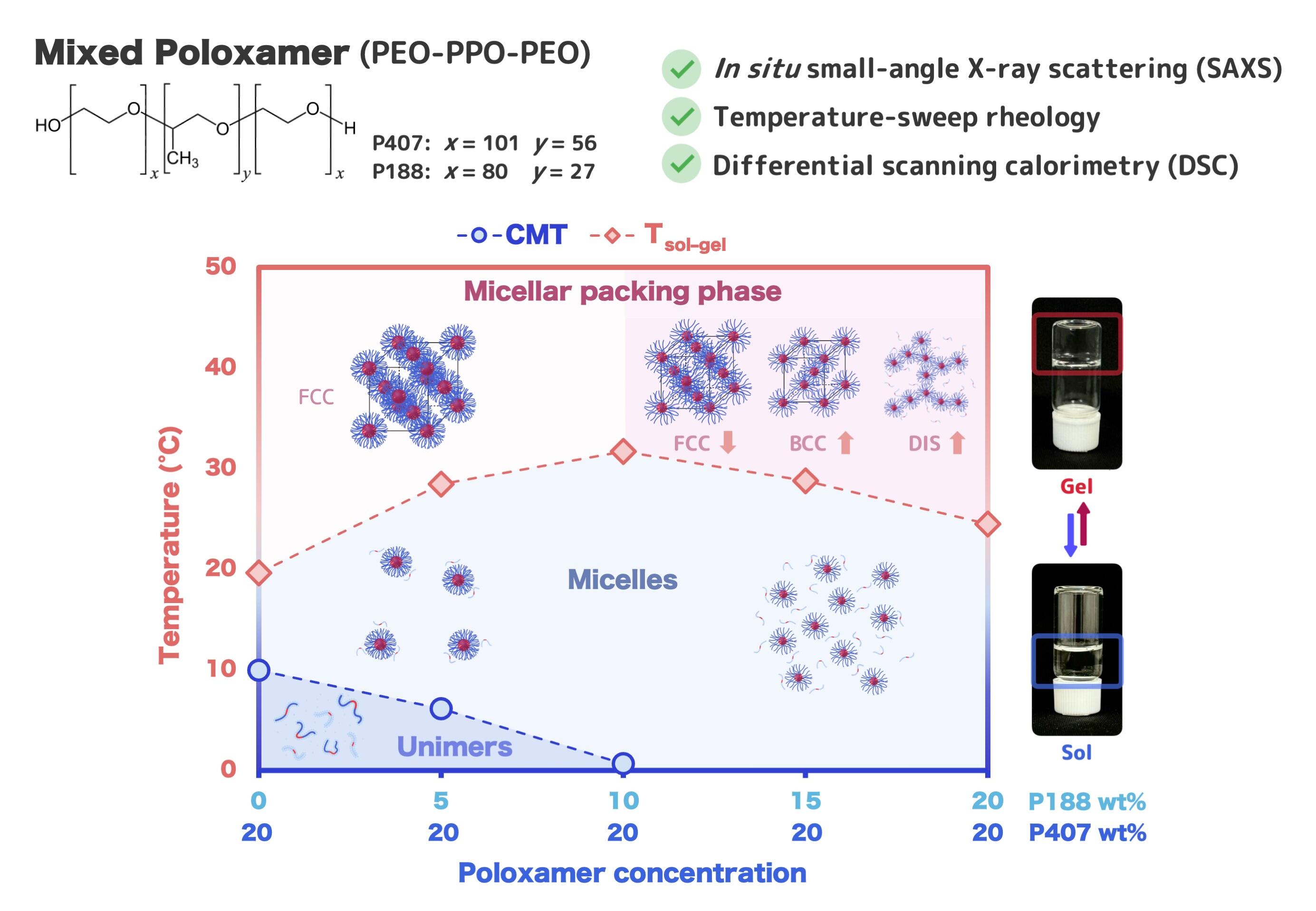
Schematic illustration of the temperature-dependent self-assembly and sol–gel transition behavior of mixed poloxamer 407 (P407) and poloxamer 188 (P188) systems. The diagram summarizes the evolution from unimers to micelles and further micellar packing upon heating, highlighting the non-straightforward shifts of the sol–gel transition temperature (Tsol–gel) as a function of P188 content. The proposed mechanism is supported by in situ small-angle X-ray scattering (SAXS), temperature-sweep rheology, and differential scanning calorimetry (DSC), linking molecular self-assembly to macroscopic gel formation.